The Many Worlds Interpretation of Quantum Physics

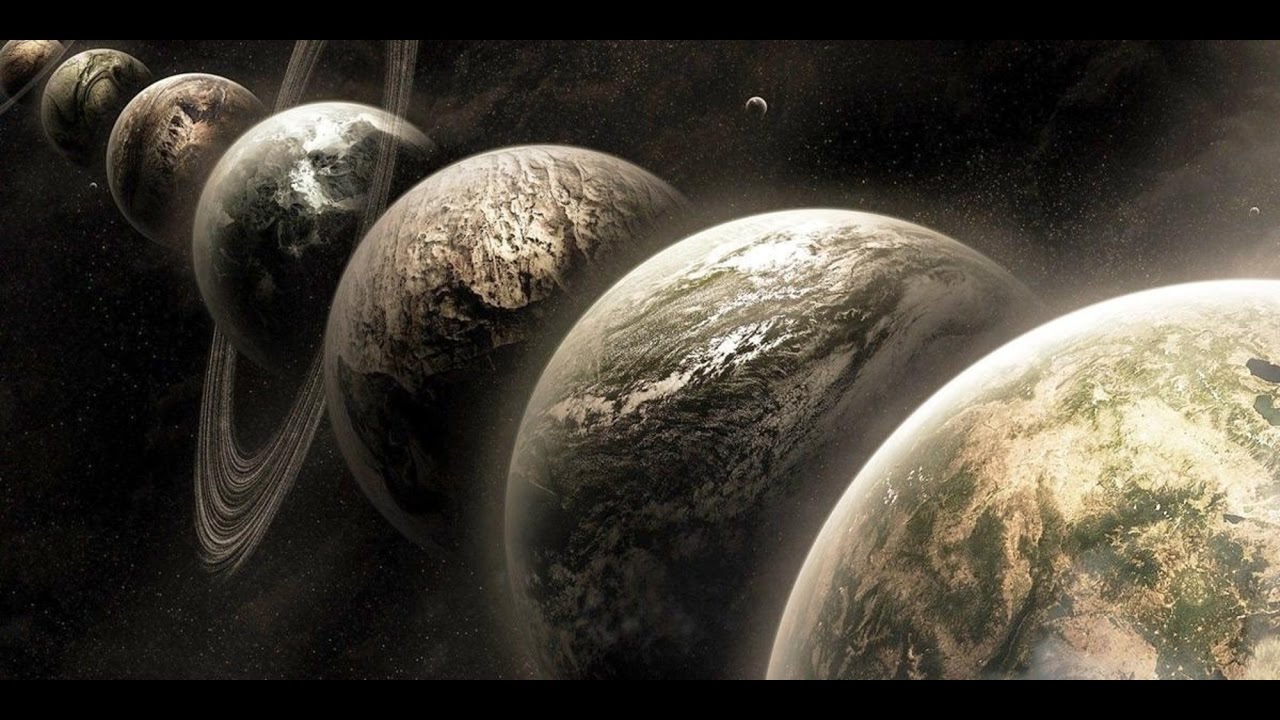
The many worlds interpretation (MWI) is a theory within quantum physics intended to explain the fact that the universe contains some non-deterministic events, but the theory itself intends to be fully deterministic. In this interpretation, every time a “random” event takes place, the universe splits between the various options available. Each separate version of the universe contains a different outcome of that event. Instead of one continuous timeline, the universe under the many worlds interpretation looks more like a series of branches splitting off of a tree limb.

For example, quantum theory indicates the probability that an individual atom of a radioactive element will decay, but there is no way to tell precisely when (within those ranges of probabilities) that decay will take place. If you had a bunch of atoms of radioactive elements that have a 50% chance of decaying within an hour, then in an hour 50% of those atoms would be decayed. But the theory tells nothing precisely about when a given atom will decay.

According to traditional quantum theory (the Copenhagen interpretation), until the measurement is made for a given atom there is no way to tell whether it will have decayed or not. In fact, according to quantum physics, you have to treat the atomas if it is in a superposition of states – both decayed and not decayed. This culminates in the famous Schroedinger’s cat thought experiment, which shows the logical contradictions in trying to apply the Schroedinger wavefunction literally.

The many worlds interpretation takes this result and applies it literally, the form of the Everett Postulate:

Everett Postulate
All isolated systems evolve according to the Schroedinger equation

If quantum theory indicates that the atom is both decayed and not decayed, then the many worlds interpretation concludes that there must exist two universes: one in which the particle decayed and one in which it did not. The universe therefore branches off each and every time that a quantum event takes place, creating an infinite number of quantum universes.

In fact, the Everett postulate implies that the entire universe (being a single isolated system) continuously exists in a superposition of multiple states. There is no point where the wavefunction ever collapses within the universe, because that would imply that some portion of the universe doesn’t follow the Schroedinger wavefunction.

History of the Many Worlds Interpretation

The many worlds interpretation was created by Hugh Everett III in 1956 in his doctoral thesis, The Theory of the Universal Wave Function. It was later popularized by the efforts of physicist Bryce DeWitt. In recent years, some of the most popular work has been by David Deutsch, who has applied the concepts from the many worlds interpretation as part of his theoretical in support of quantum computers.

Though not all physicists agree with the many worlds interpretation, there have been informal, unscientific polls which have supported the idea that it is one of the dominant interpretations believed by physicists, likely ranking just behind the Copenhagen interpretation and decoherence. (See the introduction of this Max Tegmark paper for one example. Michael Nielsen wrote a 2004 blog post (at a website which no longer exists) which indicates – guardedly – that the many worlds interpretation is not only accepted by many physicists, but that it was also the most strongly disliked quantum physics interpretation. Opponents don’t just disagree with it, they actively object to it on principle.) It is a very controversial approach, and most physicists who work in quantum physics seem to believe that spending time questioning the (essentially untestable) interpretations of quantum physics is a waste of time.

Other Names for the Many Worlds Interpretation

The many worlds interpretation has several other names, though work in the 1960s & 1970s by Bryce DeWitt has made the “many worlds” name more popular. Some other names for the theory are relative state formulation or the theory of the universal wavefunction.

Non-physicists will sometimes use the broader terms of multiverse, megaverse, or parallel universes when speaking of the many worlds interpretation. These theories usually include classes of physical concepts that cover more than just the types of “parallel universes” predicted by the many worlds interpretation.

Many Worlds Interpretation Myths

In science fiction, such parallel universes have provided the foundation for a number of great storylines, but the fact is that none of these have a strong basis in scientific fact for one very good reason:

The many worlds interpretation does not, in any way, allow for communication between the parallel universes that it proposes.

The universes, once split, are entirely distinct from each other. Again, science fiction authors have been very creative in coming up with ways around this, but I know of no solid scientific work that has shown how parallel universes could communicate with each other.
Dark Matter & Dark Energy

For more click here

Eventually theorists came up with three sorts of explanations. Maybe it was a result of a long-discarded version of Einstein’s theory of gravity, one that contained what was called a “cosmological constant.” Maybe there was some strange kind of energy-fluid that filled space. Maybe there is something wrong with Einstein’s theory of gravity and a new theory could include some kind of field that creates this cosmic acceleration. Theorists still don’t know what the correct explanation is, but they have given the solution a name. It is called dark energy.

What Is Dark Energy?

More is unknown than is known. We know how much dark energy there is because we know how it affects the universe’s expansion. Other than that, it is a complete mystery. But it is an important mystery. It turns out that roughly 68% of the universe is dark energy. Dark matter makes up about 27%. The rest – everything on Earth, everything ever observed with all of our instruments, all normal matter – adds up to less than 5% of the universe. Come to think of it, maybe it shouldn’t be called “normal” matter at all, since it is such a small fraction of the universe.

Changes in the Rate of Expansion over Time

Universe Dark Energy-1 Expanding UniverseThis diagram reveals changes in the rate of expansion since the universe’s birth 15 billion years ago. The more shallow the curve, the faster the rate of expansion. The curve changes noticeably about 7.5 billion years ago, when objects in the universe began flying apart as a faster rate. Astronomers theorize that the faster expansion rate is due to a mysterious, dark force that is pulling galaxies apart.Credit: NASA/STSci/Ann Feild

Dark Matter Core Defies Explanation

Dark Matter Core Defies ExplanationThis image shows the distribution of dark matter, galaxies, and hot gas in the core of the merging galaxy cluster Abell 520. The result could present a challenge to basic theories of dark matter.


Another explanation for how space acquires energy comes from the quantum theory of matter. In this theory, “empty space” is actually full of temporary (“virtual”) particles that continually form and then disappear. But when physicists tried to calculate how much energy this would give empty space, the answer came out wrong – wrong by a lot. The number came out 10120 times too big. That’s a 1 with 120 zeros after it. It’s hard to get an answer that bad. So the mystery continues.

Another explanation for dark energy is that it is a new kind of dynamical energy fluid or field, something that fills all of space but something whose effect on the expansion of the universe is the opposite of that of matter and normal energy. Some theorists have named this “quintessence,” after the fifth element of the Greek philosophers. But, if quintessence is the answer, we still don’t know what it is like, what it interacts with, or why it exists. So the mystery continues.

The thing that is needed to decide between dark energy possibilities – a property of space, a new dynamic fluid, or a new theory of gravity – is more data, better data.

What Is Dark Matter?

By fitting a theoretical model of the composition of the universe to the combined set of cosmological observations, scientists have come up with the composition that we described above, ~68% dark energy, ~27% dark matter, ~5% normal matter. What is dark matter?

We are much more certain what dark matter is not than we are what it is. First, it is dark, meaning that it is not in the form of stars and planets that we see. Observations show that there is far too little visible matter in the universe to make up the 27% required by the observations. Second, it is not in the form of dark clouds of normal matter, matter made up of particles called baryons. We know this because we would be able to detect baryonic clouds by their absorption of radiation passing through them. Third, dark matter is not antimatter, because we do not see the unique gamma rays that are produced when antimatter annihilates with matter. Finally, we can rule out large galaxy-sized black holes on the basis of how many gravitational lenses we see. High concentrations of matter bend light passing near them from objects further away, but we do not see enough lensing events to suggest that such objects to make up the required 25% dark matter contribution.

a2744.jpg

Abell 2744: Pandora’s Cluster RevealedOne of the most complicated and dramatic collisions between galaxy clusters ever seen is captured in this new composite image of Abell 2744. The blue shows a map of the total mass concentration (mostly dark matter).


However, at this point, there are still a few dark matter possibilities that are viable. Baryonic matter could still make up the dark matter if it were all tied up in brown dwarfs or in small, dense chunks of heavy elements. These possibilities are known as massive compact halo objects, or “MACHOs“. But the most common view is that dark matter is not baryonic at all, but that it is made up of other, more exotic particles like axions or WIMPS (Weakly Interacting Massive Particles).

Big Bang Theory

The Big Bang is the dominant (and highly supported) theory of the origin of the universe. In essence, this theory states that the universe began from an initial point or singularity which has expanded over billions of years to form the universe as we now know it.

Early Expanding Universe Findings

In 1922, Russian cosmologist & mathematician Alexander Friedman found that solutions to Einstein’s general relativity field equations resulted in an expanding universe.

As a believer in a static, eternal universe, Einstein added a cosmological constant to his equations, “correcting” for this “error” and thus eliminating the expansion. He would later call this the biggest blunder of his life.

Actually, there was already observational evidence in support of an expanding universe. In 1912, American astronomer Vesto Slipher observed a spiral galaxy (considered a “spiral nebula” at the time, since astronomers didn’t yet know that there were galaxies beyond the Milky Way) and recorded its redshift. He observed that all such nebula were traveling away from the Earth, though these results were quite controversial at the time and the full implications of them were not considered at the time.

In 1924, astronomer Edwin Hubble was able to measure the distance to these “nebula” and discovered that they were so far away that they were not actually part of the Milky Way. He had discovered that the Milky Way was only one of many galaxies and that these “nebulae” were actually galaxies in their own right.

Birth of the Big Bang

In 1927, Roman Catholic priest and physicist Georges Lemaitre independently calculated the Friedman solution and again suggested that the universe must be expanding. This theory was supported by Hubble when, in 1929, he found that there was a correlation between the distance of the galaxies and the amount of redshift inthat galaxy’s light. The distant galaxies were moving away faster, which was exactly what was predicted by Lemaitre’s solutions.

In 1931, Lemaitre went further with his predictions, extrapolating backwards in time find that the matter of the universe would reach an infinite density and temperature at a finite time in the past. This means the universe must have begun in an incredibly small, dense point of matter — a “primeval atom.”

Philosophical Side note: The fact that Lemaitre was a Roman Catholic priest concerned some, as he was putting forth a theory which presented a definite moment of “creation” to the universe. In the 20’s & 30’s, most physicists — like Einstein — were inclined to believe that the universe had indeed always existed. In essence, the Big Bang theory was seen as “too religious” by many people.

Proving the Big Bang

While several theories were presented for a time, it was really only Fred Hoyle’s steady state theory which provided any real competition for Lemaitre’s theory. It was, ironically, Hoyle who coined the phrase “Big Bang” during a 1950’s radio broadcast, intending it as a derisive term for Lemaitre’s theory.

Steady State Theory: Basically, the steady state theory predicted that new matter was created such that the density and temperature of the universe remained constant over time, even while the universe was expanding. Hoyle also predicted that denser elements were formed from hydrogen & helium through the process of stellar nucleosynthesis(which, unlike steady state, has proved to be accurate).

George Gamow — one of Friedman’s pupils — was the major advocate of the Big Bang theory. Together with colleagues Ralph Alpher & Robert Herman, he predicted the cosmic microwave background (CMB) radiation, which is a radiation that should exist throughout the universe as a remnant of the Big Bang. As atoms began to form during the recombination era, they allowed microwave radiation (a form of light) to travel through the universe … and Gamow predicted that this microwave radiation would still be observable today.

The debate continued until 1965 when Arno Penzias & Robert Woodrow Wilson stumbled upon the CMB while working for Bell Telephone Laboratories. Their Dicke radiometer, used for radio astronomy & satellite communicate, picked up a 3.5 K temperature (a close match to Alpher & Herman’s prediction of 5 K).

Throughout the late 1960s & early 1970s, some proponents of steady state physics attempted to explain this finding while still denying the Big Bang theory, but by the end of the decade, it was clear that the CMB radiation had no other plausible explanation. Penzias & Wilson received the 1978 Nobel Prize in Physics for this discovery.

Blog at WordPress.com.

Up ↑

Design a site like this with WordPress.com
Get started